







As an Amazon Associate I earn from qualifying purchases.
Quick answer: our top pick is Anker Nano 70W (3-port) (2x USB-C + USB-A · 70 W · PD).
The number of mobile devices in everyday use is constantly growing, and with it, the demands placed on power adapters. GaN technology (Gallium Nitride) is becoming the market standard. Below, we explain how this material differs from traditional silicon and what benefits it brings to wall chargers.
What is GaN?
GaN, or gallium nitride, is a semiconductor that has been used in electronics for years, including the production of LEDs and radio components. In recent years, it has begun to successfully replace silicon in wall power adapters. Traditional chargers rely on silicon (Si), which has physical limitations regarding operating frequency and heat dissipation. The use of gallium nitride allows for the design of smaller, more energy-efficient chargers capable of stable operation under heavy loads.
Fun fact: The 2014 Nobel Prize in Physics was awarded to Isamu Akasaki, Hiroshi Amano, and Shuji Nakamura for developing efficient blue gallium nitride LEDs. Without the blue LED, creating white LED lighting would not have been possible.
The use of GaN technology in chargers.
The main challenge when designing high-power power supplies is heat dissipation. Traditional silicon chargers require sufficiently large enclosures and bulky heat sinks to prevent components from overheating. The use of GaN transistors significantly reduces device dimensions while maintaining high power parameters.
As a result, modern multi-port chargers fit in the palm of your hand, offering enough power to simultaneously run a laptop, a smartphone, and other accessories from a single wall socket.
Benefits of GaN technology.
Higher energy efficiency
Chargers utilizing gallium nitride are characterized by higher energy efficiency, which means lower energy losses generated as heat. It is worth remembering that GaN itself does not speed up phone charging. Charging speed depends on the charger power and supported protocols (such as USB Power Delivery or PPS), rather than the transistor material. Gallium nitride does, however, enable the delivery of high power from a much smaller enclosure.
Smaller size and weight
Thanks to GaN technology, chargers can be significantly smaller and lighter than traditional silicon models with the same power output. Their compact dimensions ensure the charger takes up minimal space in a travel bag or backpack and does not block neighboring sockets on a power strip.
Higher power output in a compact enclosure
High efficiency allows manufacturers to fit multiple USB-C and USB-A ports into compact cases, with total power reaching 65 W, 100 W, and even more. This makes it possible to power several devices at the same time without the need for separate chargers.
How does GaN technology work?
Gallium nitride is a semiconductor that replaces some silicon transistors in chargers. GaN transistors switch at a significantly higher frequency than silicon ones (in megahertz instead of hundreds of kilohertz). As a result, the transformers, filters, and capacitors inside the power supply can be much smaller, making the entire charger more compact and lighter.
A higher switching frequency also means lower energy losses as heat. In addition, modern chargers are equipped with temperature sensors and control circuits that monitor electrical parameters in real time and adjust the power profile to the connected device.
Why choose GaN chargers?
Choosing a GaN charger is primarily about convenience resulting from compact dimensions and versatility. A single charger with sufficient power can support a smartphone, a tablet, a handheld console, and an ultrabook. Due to their high efficiency and compact form factors, GaN chargers are gradually replacing older silicon designs.
Recommended GaN chargers
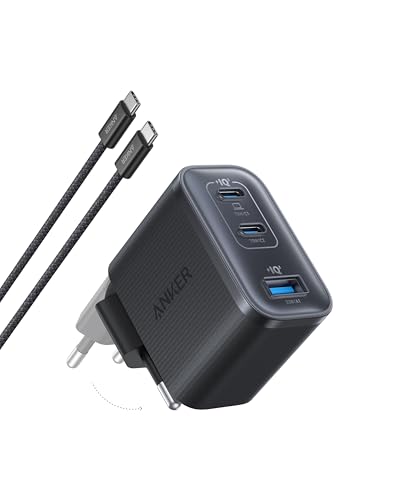
1. Anker Nano 70W (3-port)
2x USB-C + USB-A · 70 W · PD
A compact 70 W charger: laptop, phone and earbuds from one outlet. It fits in a backpack pocket, which makes it handy for travel.

2. UGREEN Nexode 65W
2x USB-C + USB-A · 65 W · PD, PPS, QC 4.0
Three ports and 65 W from a single USB-C port, enough for most 13 to 14-inch laptops. It supports USB PD with PPS for Samsung and Pixel phones and Quick Charge for older Android phones.
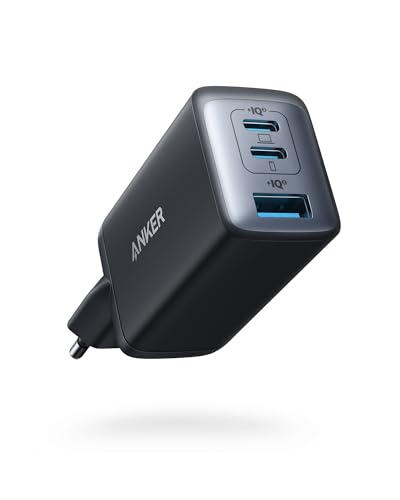
3. Anker 735 (Nano II 65W)
2x USB-C + USB-A · 65 W · PD, PPS
A small GaN charger with 65 W from one USB-C port. It is enough for a laptop that charges over USB-C; with two devices plugged in, the power is split between the ports.
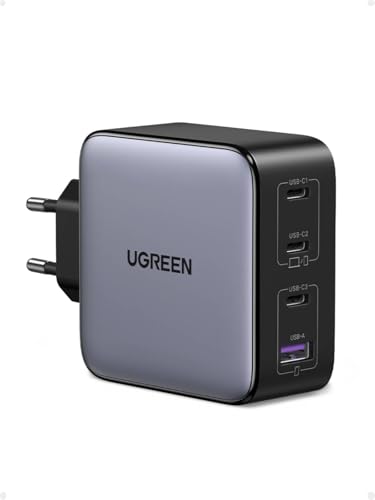
4. UGREEN Nexode 100W
3x USB-C + USB-A · 100 W · PD, PPS
Up to 100 W from one USB-C port, so it also charges a larger laptop along with your phone and earbuds. Four ports replace several separate chargers on the desk or in your suitcase.
Summary
GaN technology represents a significant step forward in the design of switched-mode power supplies. It combines high power, compact size, and low heat generation. A well-chosen charger of this type helps reduce the number of power supplies used at home, in the office, and while traveling.
Sources
- Navitas: The GaN Revolution in Fast Charging & Power Conversion - manufacturer page (navitassemi.com)
- Phihong: Why Are GaN Chargers Better Than Silicon-Based Chargers? - industry article (phihong.com)
- NobelPrize.org: The 2014 Nobel Prize in Physics - Press release - industry article (nobelprize.org)
- USB-IF: USB Charger (USB Power Delivery) - industry article (usb.org)


Leave a comment
This site is protected by hCaptcha and the hCaptcha Privacy Policy and Terms of Service apply.