


As an Amazon Associate I earn from qualifying purchases.
Quick answer: our top pick is Amazon Basics Qi2.2 25 W (Qi2.2 · 25 W · pad).
Inductive charging has become one of the most convenient ways to power mobile devices. It helps avoid cable clutter, reduces port wear and tear, and makes everyday device use easier. Below, we discuss the key aspects of wireless chargers: from how they work and their compatibility, to available power standards.
How does an inductive charger work?
Inductive charging, also known as wireless charging, is based on the phenomenon of electromagnetic induction. This process occurs in three stages:
- Generation of an electromagnetic field: The charger features a transmitter coil that generates an alternating magnetic field when connected to a power source.
- Energy transfer: The magnetic field induces an electric current in the receiver coil built into the phone or headphone case.
- Energy conversion: The alternating current is rectified and delivered to the device's battery as direct current.
The entire process takes place without plugging a cable directly into the phone. Magnetic solutions additionally ensure that the transmitter and receiver coils are aligned perfectly with each other.
Fun fact: The name of the Qi standard (pronounced "chee") comes from the Chinese word qì, meaning life energy. The first version of this specification debuted in 2010.
Types of inductive chargers
1. Standard inductive chargers
Basic stands and pads, compatible with most devices supporting the universal Qi standard.
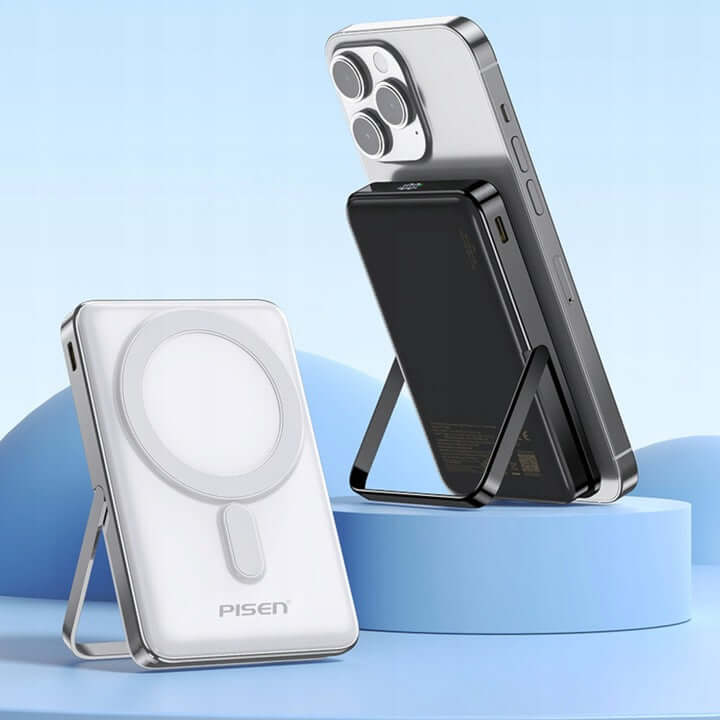
2. Magnetic chargers (MagSafe and Qi2)
Equipped with a ring of magnets that automatically aligns the smartphone at the optimal charging point, eliminating the issue of accidental misalignment.
Fun fact: The Qi2 standard was created directly on the basis of MagSafe technology, after Apple shared its Magnetic Power Profile specification with the WPC consortium.
3. Multifunctional charging stations
2-in-1 or 3-in-1 designs that allow charging a smartphone, smartwatch, and wireless earbuds in one place.
Device compatibility with inductive chargers
The Qi wireless power standard, developed by the Wireless Power Consortium (WPC), is widely used in devices across many brands:
- Smartphones: iPhone 8 and newer, flagship models from the Samsung Galaxy and Google Pixel series, and other compatible phones.
- Headphones: AirPods with a wireless charging case, Galaxy Buds, and other Qi-supported accessories.
- Smartwatches: including Apple Watch and Samsung Galaxy Watch (using dedicated charging modules).
For iPhones, traditional Qi chargers limit transfer to 7.5 W, while full speed is provided by MagSafe and Qi2 compliant accessories.
Inductive charging power
Wireless chargers offer various power levels depending on the standard used and the connected model:
- 5 W - 7.5 W: Basic charging power; the standard Qi specification delivers a maximum of 7.5 W on iPhones.
- 10 W - 15 W: The Qi2 standard uses magnets for precise coil alignment and enables 15 W charging.
- 25 W: The Qi2.2 (Qi2 25 W) standard increases wireless charging power to 25 W for iPhone 16 and newer generations. For Android smartphones, supported power depends on the specific phone model.
Why choose an inductive charger?
1. Convenience of use
Charging starts as soon as you place your phone on the stand. In magnetic models, magnets stabilize the phone's position, preventing any interruption to the charging process.
2. Charging port protection
Using the USB-C or Lightning port less frequently protects it from mechanical wear and dirt accumulation.
3. Desk organization
Multi-device charging stations allow you to power a phone, watch, and earbuds using a single power cable, eliminating the need for multiple separate chargers.
4. Safety
Certified designs feature built-in protection circuits against overheating, power surges, and the presence of foreign metallic objects on the charging surface.
Recommended wireless chargers in 2026

1. Amazon Basics Qi2.2 25 W
Qi2.2 · 25 W · pad
The most affordable way to get 25 W wireless charging. The pad is Qi2.2 certified, so iPhone 16 and newer charge at full speed, while older MagSafe models charge as fast as they can.

2. Anker Zolo Qi2 15 W
Qi2 · 15 W · pad
A straightforward magnetic charging pad with Qi2 15 W certification. Great for a nightstand, though you need your own power adapter.

3. UGREEN MagFlow 2-in-1 Foldable, Qi2 25 W
Qi2 · 25 W · 2-in-1 · foldable
A foldable 2-in-1 charger with Qi2 25 W. Fits easily into a backpack, making it ideal for travel and the office.
Frequently Asked Questions (FAQ)
1. Does a wireless charger work with every phone?
No. The smartphone must have a built-in induction coil compatible with the Qi, Qi2, or MagSafe standard (this feature is offered by iPhone 8 and newer, as well as selected Android devices).
2. Is wireless charging slower than wired charging?
Usually yes, because wired charging achieves higher power outputs with less energy loss, although the Qi2 15 W and Qi2.2 25 W standards have significantly narrowed this gap.
3. Can I use a phone case during wireless charging?
Most traditional cases up to 3-4 mm thick do not interfere with charging, as long as they do not contain metal plates. For magnetic chargers, cases with a built-in magnetic ring are recommended.
4. Does a wireless charger consume more power?
Yes, due to the lower efficiency of wireless transfer, some energy is dissipated as heat, making this process slightly less efficient than charging with a cable.
5. How to choose a wireless charger for an iPhone?
For optimal results, it is worth choosing chargers compatible with the Qi2 or MagSafe standard, which ensures a stable magnetic mount and a charging power of 15 W (or 25 W with the Qi2.2 standard for newer generations).
6. Are magnetic chargers safe for the battery?
Yes, built-in protections automatically regulate current parameters and reduce power when the device's temperature rises.
Summary
Wireless chargers are a practical way to conveniently top up phones and accessories every day. When choosing a model for yourself, consider the supported power output, compatibility with Qi2 or MagSafe magnetic standards, and the presence of essential thermal protections.
Sources
- Wireless Power Consortium (twórca standardu Qi) - manufacturer page (wirelesspowerconsortium.com)
- Wikipedia: Qi (standard) - industry article (en.wikipedia.org)
- The Verge: Qi2, the MagSafe-like wireless charging standard - industry article (theverge.com)
- Macworld: Which magnetic wireless speed is my iPhone - industry article (macworld.com)


Leave a comment
This site is protected by hCaptcha and the hCaptcha Privacy Policy and Terms of Service apply.