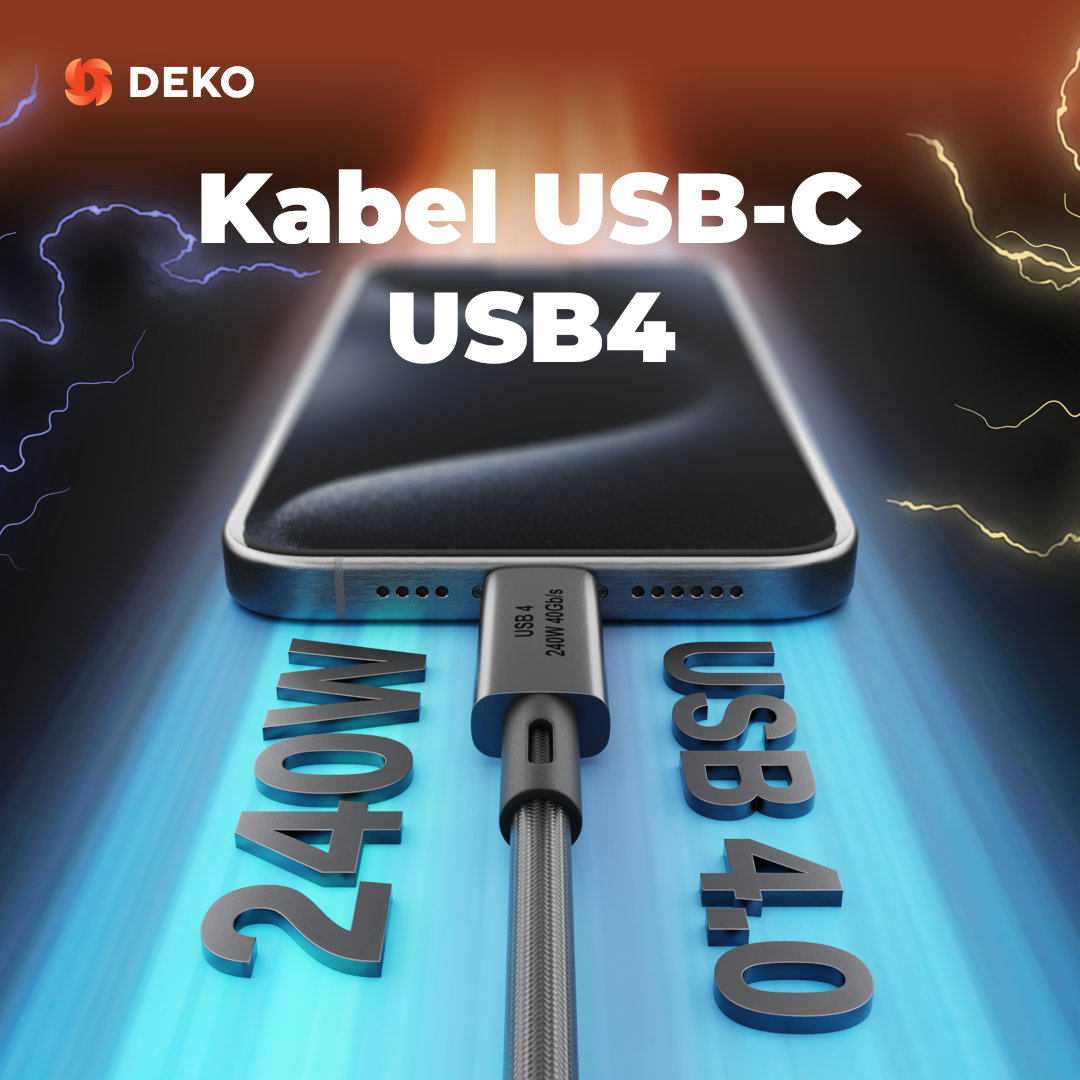
Thunderbolt 4 i USB4: Przyszłość szybkich połączeń oraz rola kabli USB-C The future of connectivity: Thunderbolt 4 vs USB4 In an era where technology is advancing at a staggering pace, understanding the differences between connectivity standards such as Thunderbolt 4 and USB4 is becoming essential. While these interfaces share many features, they also have distinctive functions that set them apart. So how do you choose the right type of connection for your devices, such as DEKO’s versatile USB‑C cable? What is Thunderbolt 4? Thunderbolt technology, developed by Intel and Apple, has revolutionized the market since its debut in 2011. Thunderbolt 4, the latest version, offers a maximum bidirectional bandwidth of 40 Gbps, making it four times faster than USB 3.2 Gen 1. This technology allows you to connect up to five Thunderbolt devices to a single computer and is backward compatible with previous Thunderbolt versions thanks to the USB‑C connector. The power of Thunderbolt 4 doesn’t end there. It supports two 4K 60Hz monitors or one 8K 60Hz monitor, and it also offers advanced power options for various devices, including laptops. This makes cables like DEKO’s USB‑C, which are compatible with Thunderbolt 4, extremely versatile for both data transfer and charging. What is USB4? USB4, introduced by the USB Implementers Forum in 2019, is based on the Thunderbolt protocol and also offers speeds of up to 40 Gbps. It is backward compatible with earlier USB standards, but requires adapters because it uses the USB-C connector. Unlike Thunderbolt 4, USB4 does not natively support two monitors, but it can handle output to a single display, supporting resolutions up to 8K and even 16K. A key feature of USB4 is its variable data and power throughput, depending on the device. Some USB4 devices support speeds up to 20 Gbps, while others can reach as high as 40 Gbps. Because of this variability, it’s worth checking the specifications of products like DEKO’s USB‑C cable to make sure they meet your requirements. Thunderbolt 4 and USB4: Similarities and differences At first glance, Thunderbolt 4 and USB4 look very similar — both use USB-C and support speeds up to 40 Gbps. The differences, however, lie in the details. Thunderbolt 4 always offers a minimum speed of 32 Gbps and delivers 15 W of power, while USB4 capabilities may vary. Thunderbolt 4 also has an advantage in cable length — it maintains 40 Gbps speeds over lengths of up to 2 meters, whereas USB4 drops to 20 Gbps with cables longer than one meter. How to choose between Thunderbolt 4 and USB4? When deciding between Thunderbolt 4 and USB4, it’s worth considering your individual needs. If performance is the priority and price is no object, Thunderbolt 4, with its higher minimum requirements and additional features, will be the better choice. For those looking for more affordable solutions without compromising on quality, USB4 is the right option, especially when paired with reliable accessories such as DEKO’s USB‑C cable. Applications In the Thunderbolt 4 versus USB4 showdown, both standards have their advantages. Thunderbolt 4 stands out for its versatility and high performance, while USB4 offers flexibility and a better price. Whatever you choose, make sure your accessories, such as the USB-C cable from DEKO, are compatible with the selected standard so you can fully tap into your hardware’s potential. Impact on practice: USB‑C cable from Deko Electronics The USB‑C cable from Deko Electronics supports USB4 and Thunderbolt 4 technologies, combining high data transfer speed with support for advanced display solutions, offering support for 8K, 240 W and 40 Gbps, which makes it an ideal choice for advanced users. Podsumowanie The choice between Thunderbolt 4 and USB4 depends on the specific needs and requirements of your device. Both technologies play a key role in the future of high‑speed digital connectivity, offering high performance and versatility. However, it’s worth remembering that by choosing a DEKO cable, you can be sure compatibility is one less thing to worry about.








Leave a comment
This site is protected by hCaptcha and the hCaptcha Privacy Policy and Terms of Service apply.