


As an Amazon Associate I earn from qualifying purchases.
Quick answer: our top pick is INIU 20000mAh 45W (20,000 mAh · 45 W USB PD · built-in USB-C cable).
Best power bank for iPhone 17 Pro?
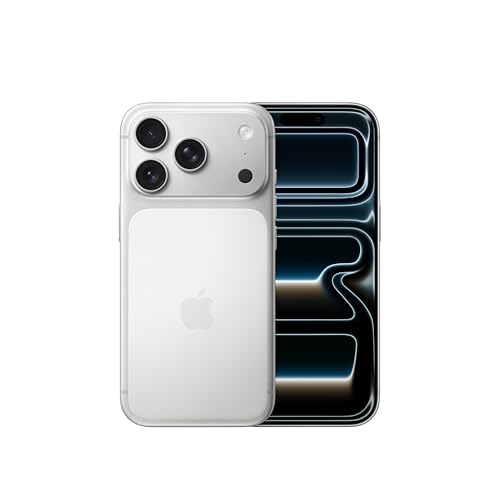
For the iPhone 17 Pro, it is best to choose a magnetic model in the new Qi2.2 standard with 25 W of power, as it charges the phone wirelessly the fastest. If you only need handy backup for the evening, a smaller Qi2 15 W power bank will be more than enough. If, on the other hand, you care about maximum speed and want to utilize the full 35 W, a traditional USB-C cable connection remains the best choice.
The iPhone 17 Pro has a 3998 mAh battery, and you will not find any power adapter in the box. Choosing the right power bank therefore depends on whether you prefer cable-free convenience on the back of your phone, or you want the fastest possible top-up on the go.
Qi2.2, Qi2 standards and older magnetic solutions
The difference between wireless charging generations mainly comes down to power and temperature control. The new Qi2.2 standard allows charging the iPhone 17 Pro wirelessly at up to 25 W, provided it runs iOS 26. The older Qi2 standard delivers a maximum of 15 W, and power banks compatible with older MagSafe without official certification often slow down to just 7.5 W.
Magnets in the Qi2 and Qi2.2 standards precisely align the charging coils, which reduces energy loss. At 25 W, however, the phone can heat up, and the battery protection electronics then reduce the charging speed. That is why some manufacturers use active fan cooling, which helps maintain the declared performance for a longer time.
According to manufacturer data, the Anker MagGo 2 Pro with a fan charges the iPhone 17 Pro battery to 25% in 10 minutes and to 50% in 25 minutes. Meanwhile, the Baseus AM52 model without a cable reaches 45% in 30 minutes. With the Qi2 15 W standard, this process takes noticeably longer, but such equipment puts less thermal stress on the cells.
Fun fact: The Qi2.2 standard with 25 W wireless charging works exclusively on Apple series 16 and 17 smartphones running iOS 26.
Below, we have compiled the recommended magnetic and wired power banks that work best with the charging specifications of this model.
Recommended power banks for iPhone 17 Pro

1. INIU 20000mAh 45W
20,000 mAh · 45 W USB PD · built-in USB-C cable
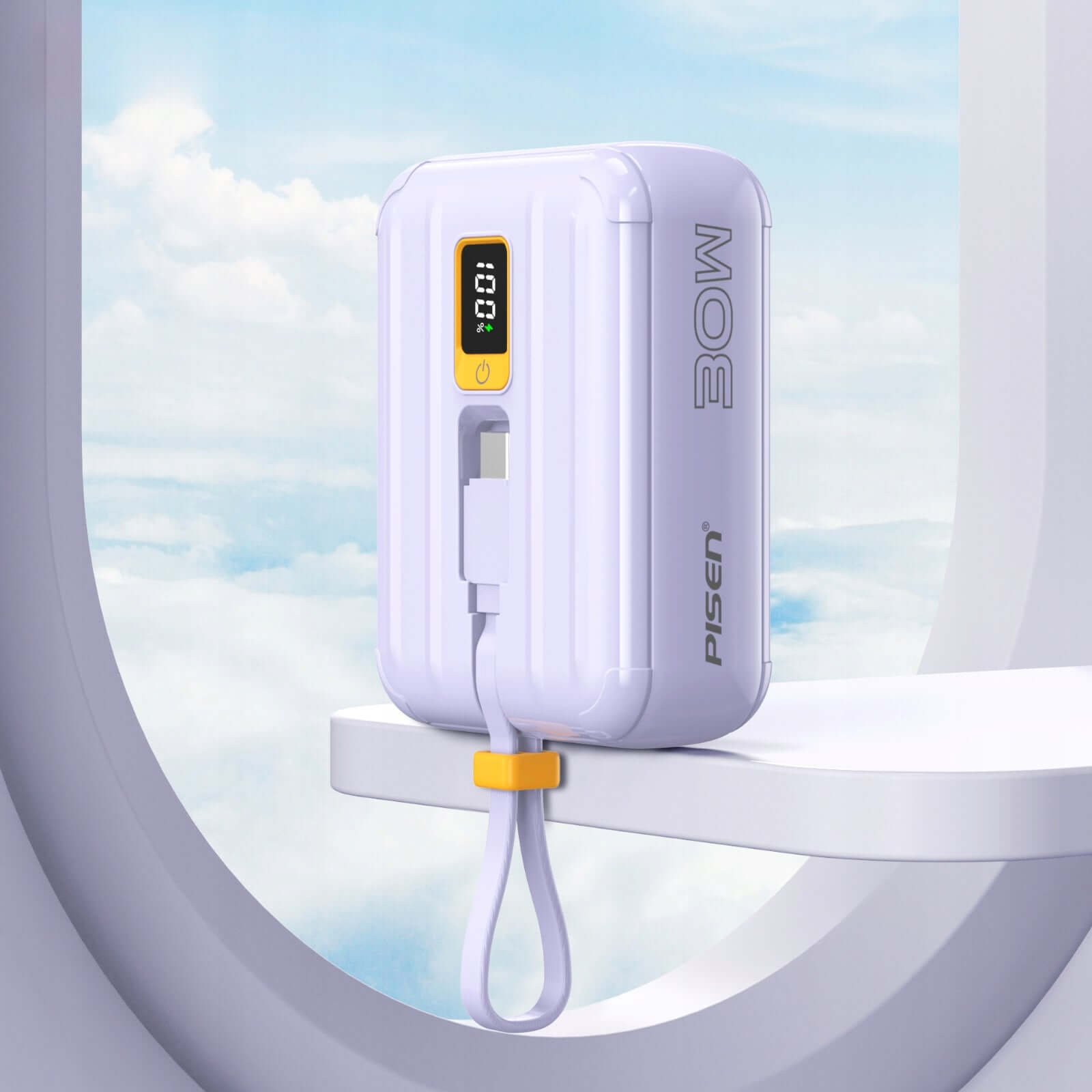
The number one power bank on Amazon. 20,000 mAh, up to 45 W over USB-C and a built-in cable, so there is no extra cable to carry.

2. Anker Nano Power Bank Qi2 5000mAh
5,000 mAh · magnetic Qi2 15 W · ultra-slim
The best-selling magnetic power bank. It snaps onto the back of an iPhone and charges it wirelessly at 15 W. 5,000 mAh is a top-up for the evening, not a full charge.

3. Anker MagGo Power Bank 2 Pro Qi2.2 25W
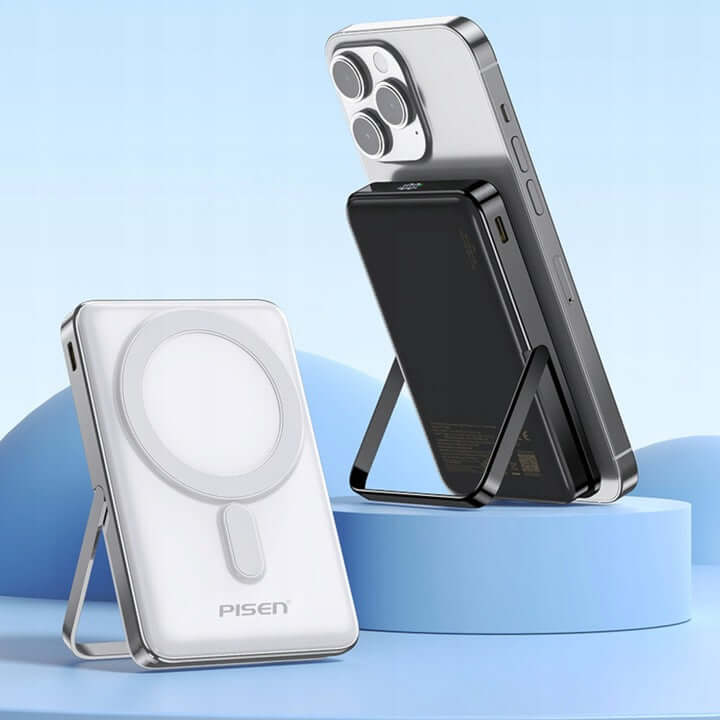
10,000 mAh · magnetic Qi2.2 25 W · 45 W over USB-C · fan
The fastest magnetic power bank here: Qi2.2 at 25 W and an active cooling fan so the power doesn't drop. Anker quotes 50% on an iPhone 17 Pro in 25 minutes. iPhone only, not for Android.

4. Baseus PicoGo AM52 Qi2.2 25W 10000mAh
10,000 mAh · magnetic Qi2.2 25 W · 45 W over USB-C · 0.6 in thin
Qi2.2 certified, so iPhone 16 and 17 models charge wirelessly at the full 25 W. Over USB-C it delivers 45 W, enough for a Samsung too. Baseus quotes 45% on an iPhone 17 Pro in 30 minutes.

5. INIU Qi2.2 25W 10000mAh
10,000 mAh · magnetic Qi2.2 25 W · very slim
The cheapest way to get the full 25 W wirelessly on new iPhones: Qi2.2, 10,000 mAh and a slim body.
5000, 10,000, or 20,000 mAh Capacity vs. Weight on the Back of the Phone
The rated capacity of power banks is specified for internal cells with a voltage of 3.7 V, so 5000 mAh means approximately 18.5 Wh, 10,000 mAh is 37 Wh, and 20,000 mAh corresponds to 74 Wh. Voltage converters and heat loss mean that approximately 72% of the energy stored in the cells actually reaches the phone. With wireless charging, the losses are even greater than when using a cable.
In practice, this means that a pocket-sized 5000 mAh model will charge the 3998 mAh battery in the iPhone 17 Pro about 0.9 times, serving as a lightweight emergency top-up. A 10,000 mAh version via cable will replenish the phone about 1.8 times, although with magnetic charging this result will be slightly lower. In turn, a large 20,000 mAh power bank will provide about 3.5 full wired charges.
When choosing a magnetic model, you must keep in mind the comfort of holding the phone in your hand. A 5000 mAh power bank is lightweight, slim, and barely noticeable on the back of the case. A 10,000 mAh capacity significantly thickens the smartphone and adds weight, while 20,000 mAh designs are best carried in a backpack and connected to the phone with a long cable.
Fun fact: Airline regulations allow power banks with a capacity of up to 100 Wh in carry-on luggage, so 20,000 mAh and 25,000 mAh models fall within this limit without requiring additional permits.
When Is It Better to Plug in a Traditional USB-C Cable?
When you are short on time before leaving the house, a USB-C Power Delivery cable is unbeatable. GSMArena tests show that wired, the iPhone 17 Pro reaches a peak power of around 35 W. As a result, the battery reaches 40% in 15 minutes, 70% in 30 minutes, and a full charge to 100% takes 1 hour and 18 minutes.
Apple itself claims a 50% charge in 20 minutes using a 40 W power adapter. No wireless power bank comes close to these results, as inductive charging releases more energy as heat. If you are standing at a train station or have fifteen minutes before leaving for work, a cable connected to a USB PD port will give you the most percentage in the shortest time.
It is also worth knowing that GSMArena tests showed no difference in charging speed between 45 W chargers and more powerful power adapters. The phone simply does not draw more than about 35 W, so a power bank with a 45 W output fully maxes out its capabilities.
Frequently Asked Questions About Power Banks for iPhone 17 Pro
Which MagSafe power bank for iPhone 17 Pro should you choose?
The best choice is a model compatible with the 25 W Qi2.2 standard, such as the Anker MagGo 2 Pro or Baseus AM52. If you are looking for something smaller and lighter for evening outings, the popular 15 W Anker Nano Qi2 is a great option. Make sure the device has built-in magnets that stabilize the phone while carrying it in your pocket.
Does the iPhone 17 Pro charge from a Qi2.2 power bank at 25 W?
Yes, this smartphone model supports wireless charging at full power up to 25 W using certified Qi2.2 accessories. iOS 26 is required to achieve this speed. Keep in mind that due to temperature, full power is maintained primarily at the beginning of the charging cycle.
How many times will a 10,000 mAh power bank charge the iPhone 17 Pro?
A 10,000 mAh power bank will charge the iPhone 17 Pro about 1.8 times via a USB-C cable connection. When using Qi2 or Qi2.2 wireless charging, energy losses are higher, so in practice you will get around 1.3 to 1.5 full charges. This is because converters and magnetic coils release part of the energy as heat.
Is a 15 W Qi2 power bank enough for iPhone 17 Pro?
Such a power bank is completely sufficient if you use it for topping up energy throughout the day. It charges the phone slower than a 25 W Qi2.2 adapter, but it is usually cheaper and heats up the chassis less. For people who recharge their smartphone at a desk or in the car, 15 W is a perfectly satisfactory value.
Is it faster to charge the iPhone 17 Pro from a power bank with a cable or wirelessly?
Charging with a USB-C Power Delivery cable is noticeably faster, as the smartphone then draws a peak of around 35 W. According to GSMArena tests, this allows you to reach 70% battery in 30 minutes, while the fastest Qi2.2 wireless power banks achieve between 45% and 50% in that time. The cable also wins in terms of energy efficiency.
Sources
- Apple: Apple iPhone 17 Pro - manufacturer page (support.apple.com)
- GSMArena: Apple iPhone 17 Pro - industry article (gsmarena.com)
- 9to5Mac: Apple iPhone 17 Pro - industry article (9to5mac.com)
- GSMArena: Apple iPhone 17 Pro - industry article (gsmarena.com)
- 9to5Mac: Apple iPhone 17 Pro - industry article (9to5mac.com)


Leave a comment
This site is protected by hCaptcha and the hCaptcha Privacy Policy and Terms of Service apply.